 HR
HR DE
DE FR
FR IT
ITCroatia Bucket List
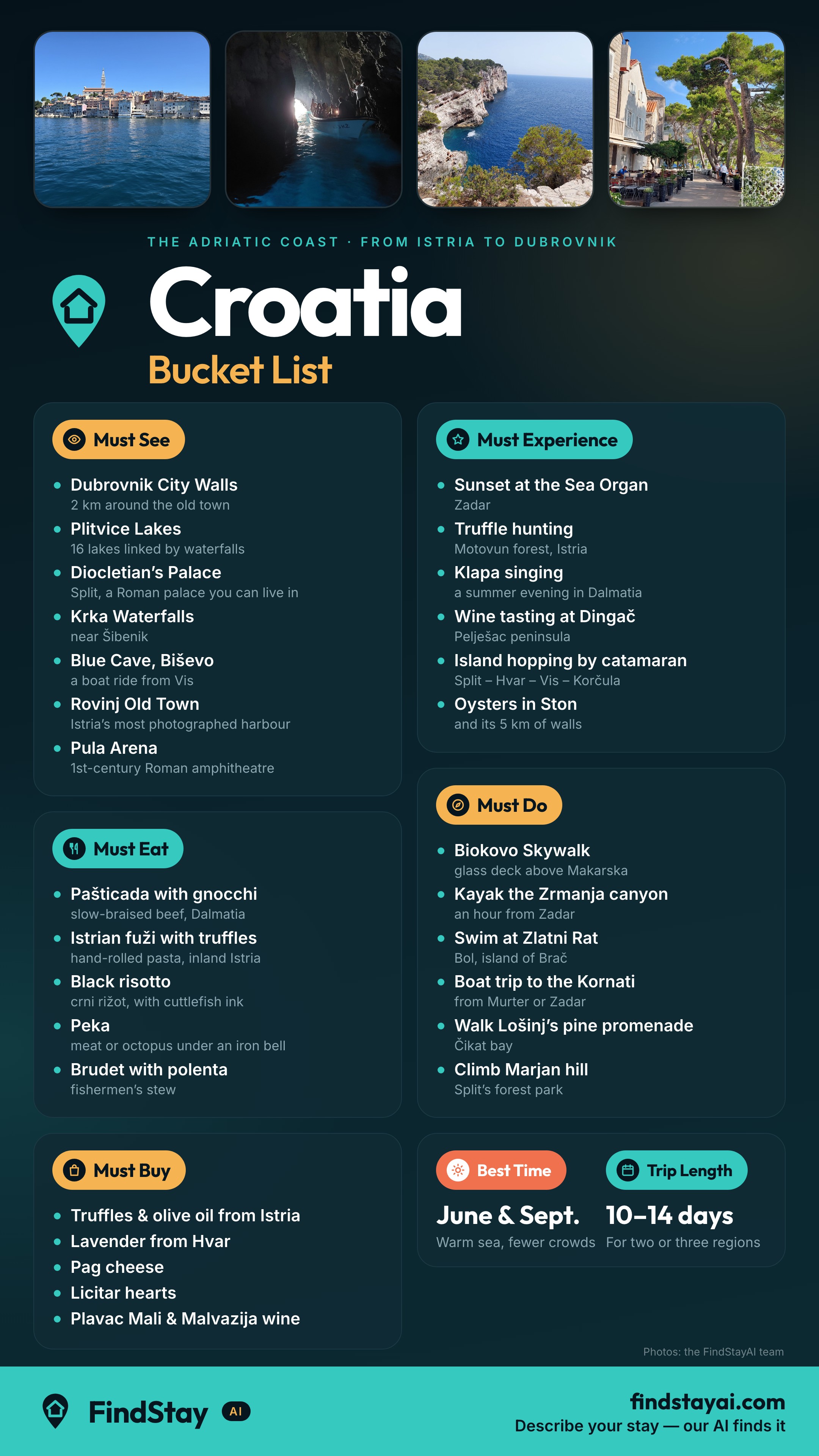
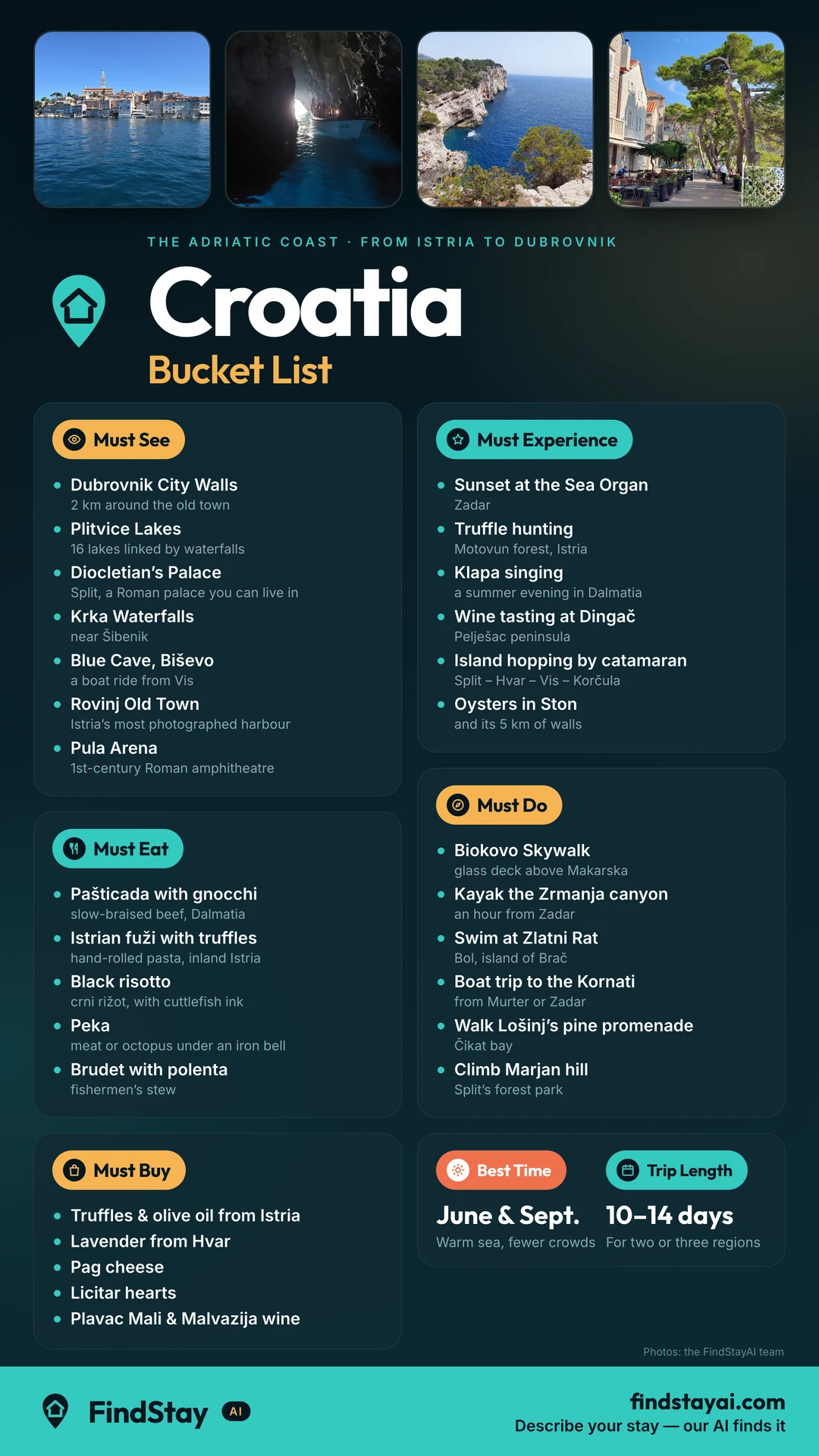
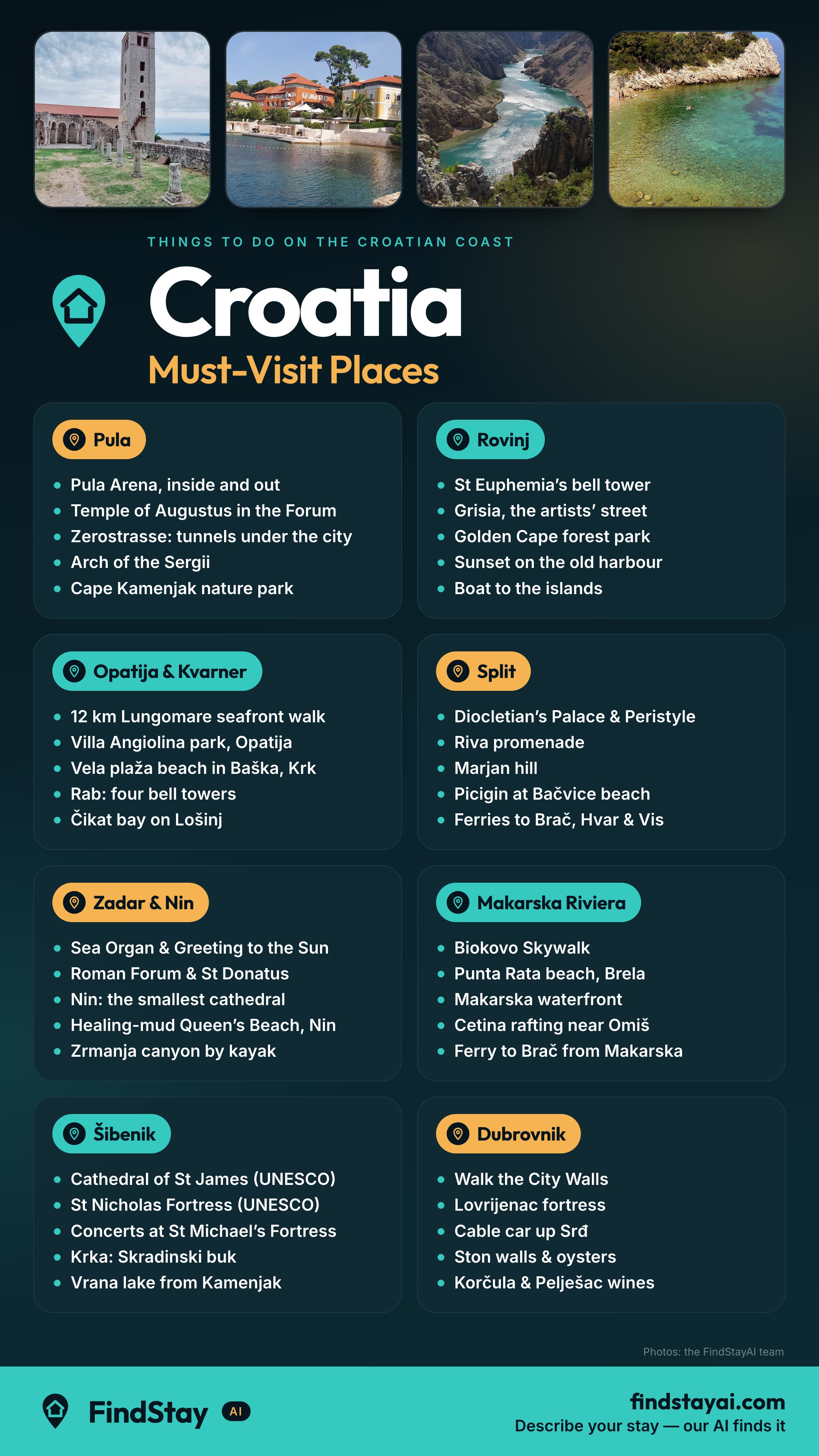
Our local team’s short list of the Croatian coast: the places worth the queue, the dishes worth the detour and the things you’ll still talk about at home. Save the infographic, then read on for the details behind every line.
Must see
Dubrovnik City Walls
Almost two kilometres of walls loop around the old town, with views over terracotta roofs on one side and the open sea on the other. Go at opening time or in the last two hours of the day — the midday sun on the stone is fierce. Where to stay: our Dubrovnik guide.
Plitvice Lakes
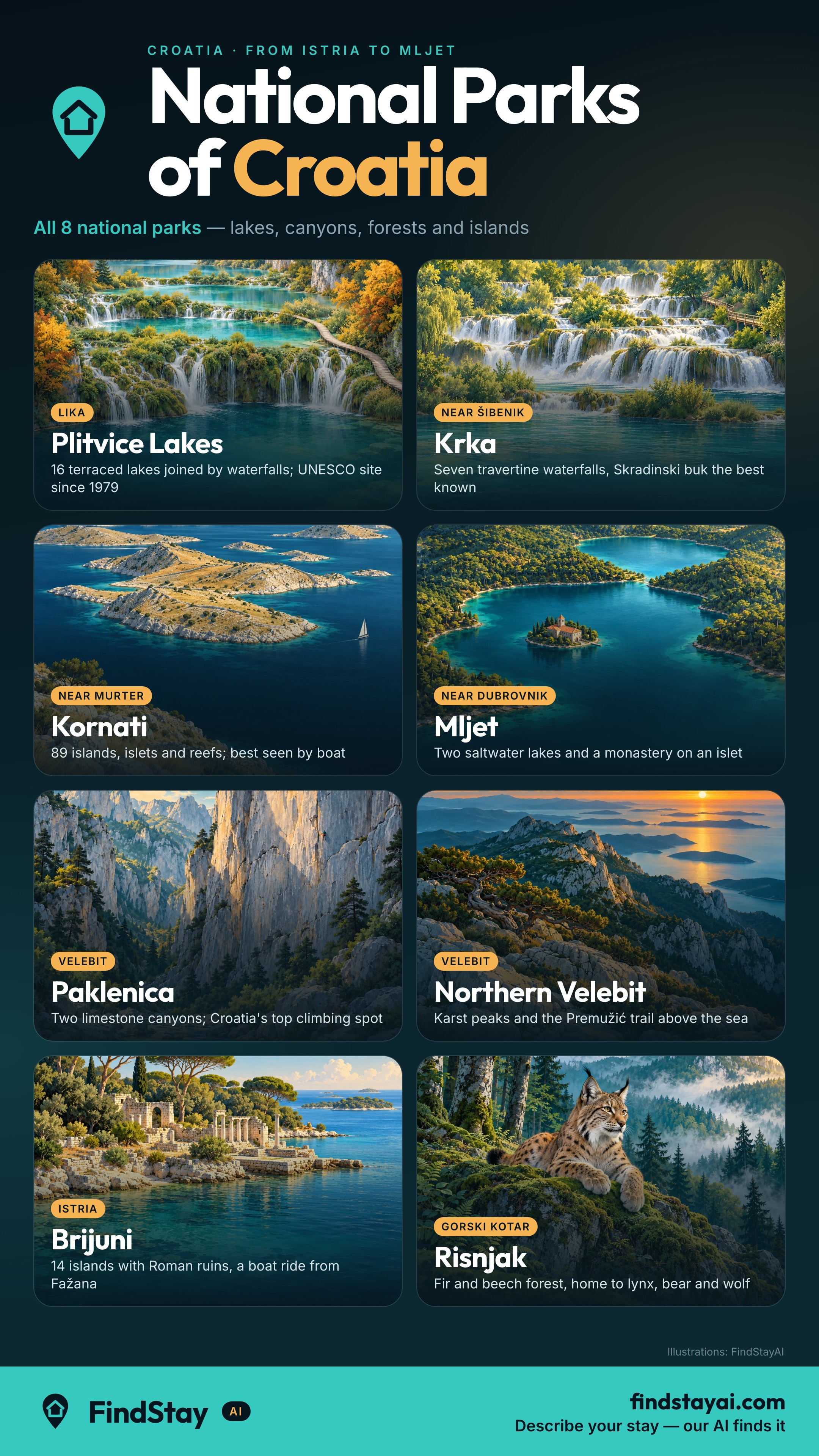
Sixteen terraced lakes joined by waterfalls, in Croatia’s oldest and largest national park. It sits inland, roughly two hours by car from Zadar, so it pairs best with a stay in the Zadar region or a stop on the drive down the coast. Buy tickets online in summer — entry is by time slot.
Diocletian’s Palace, Split
A Roman emperor’s retirement palace from around 300 AD that never stopped being lived in: cafés in the cellars, flats above the arches, concerts on the Peristyle. See our Split guide.
Krka Waterfalls
Skradinski buk is the famous cascade of the Krka National Park, a short drive from Šibenik. Swimming under the falls is no longer allowed, but the boardwalks are worth every step. Stay in or around Šibenik.
Blue Cave on Biševo
On sunny late mornings, light enters the cave through an underwater opening and turns the water electric blue. Boats leave from Komiža on Vis; calm sea is a must, so keep a spare day.
Rovinj old town
Pastel houses rising out of the sea and crowned by the bell tower of St Euphemia — the most photographed harbour in Istria. Our Rovinj guide covers where to stay.
Pula Arena
One of the best-preserved Roman amphitheatres anywhere, still used for summer concerts and film screenings. Base yourself in Pula or nearby Medulin.
Must eat
Five dishes that tell the story of the coast, from Istria’s truffle forests to Dalmatia’s fishing villages.
Pašticada with gnocchi
Dalmatia’s festive dish: beef marinated in vinegar, then braised for hours with prunes, wine and prošek (a sweet dessert wine) until the sauce turns dark and glossy. It’s served with home-made gnocchi (njoki). Look for it on Sunday lunch menus in Split and along the Makarska Riviera.
Istrian fuži with truffles
Fuži are hand-rolled pasta quills from Istria; with freshly shaved truffles and a little butter or cream they become the region’s signature plate. White truffle season peaks in autumn, black truffles are around most of the year. Find them in the hill towns of central Istria.
Black risotto (crni rižot)
Rice cooked with cuttlefish or squid and its ink — jet black, rich and sea-salty. Every konoba on the coast has its own version; expect black teeth and no regrets.
Peka
Lamb, veal or octopus with potatoes, slow-cooked under an iron bell covered with embers. It takes hours, so most taverns ask you to order a day ahead — ask your host to call for you.
Brudet with polenta
A fishermen’s stew of several kinds of fish simmered in tomato, wine and olive oil, traditionally spooned over soft polenta. Ask for it in fishing towns from Kvarner down to Dalmatia — it’s a dish that’s best where the boats come in.
Must experience
- Sunset at the Sea Organ, Zadar — waves play marble steps on the waterfront, and next to it the Greeting to the Sun lights up after dark. More in our Zadar guide.
- Truffle hunting near Motovun — walk the Mirna valley forest with a truffle hunter and their dogs, then eat what you find.
- Klapa singing — traditional a cappella harmony (on UNESCO’s list of intangible heritage), at its best on a summer evening in a Dalmatian square.
- Wine tasting at Dingač — Plavac Mali from vineyards so steep they plunge straight to the sea on the Pelješac peninsula.
- Island hopping by catamaran — fast passenger lines link Split with Hvar, Vis and Korčula; car ferries are slower but take you anywhere.
- Oysters in Ston — eaten on the shore of Mali Ston bay, after a walk along the five kilometres of medieval walls.
Must do
- Biokovo Skywalk — a glass horseshoe over the cliffs above the Makarska Riviera.
- Kayak the Zrmanja canyon — emerald river between karst walls, about an hour from Zadar.
- Swim at Zlatni Rat — the pebble spit near Bol on Brač that shifts with the wind.
- Boat trip to the Kornati — a stark archipelago of 89 islands, islets and reefs; day trips leave from Murter, Biograd and Zadar.
- Walk Lošinj’s pine promenade — the shaded seafront path to Čikat bay.
- Climb Marjan hill — Split’s forest park, with pine-shaded coves on the far side.
Must buy
- Truffles and olive oil from Istria — buy oil straight from the mill after the autumn harvest.
- Lavender from Hvar — sachets and essential oil from the island’s fields.
- Pag cheese (paški sir) — hard sheep’s cheese with a salty, herby edge from island grazing.
- Licitar hearts — red, decorated honey-dough hearts from northern Croatia, on UNESCO’s list.
- Wine — Plavac Mali from Dalmatia, Malvazija from Istria.
Best time and how long to stay
June and September are the sweet spot: the sea is warm, the crowds are thinner than in July and August and prices are lower. Plan 10 to 14 days to see two or three regions without spending your holiday in the car — for example Istria and Kvarner, or Zadar, Šibenik and Split.
Our Croatia infographics
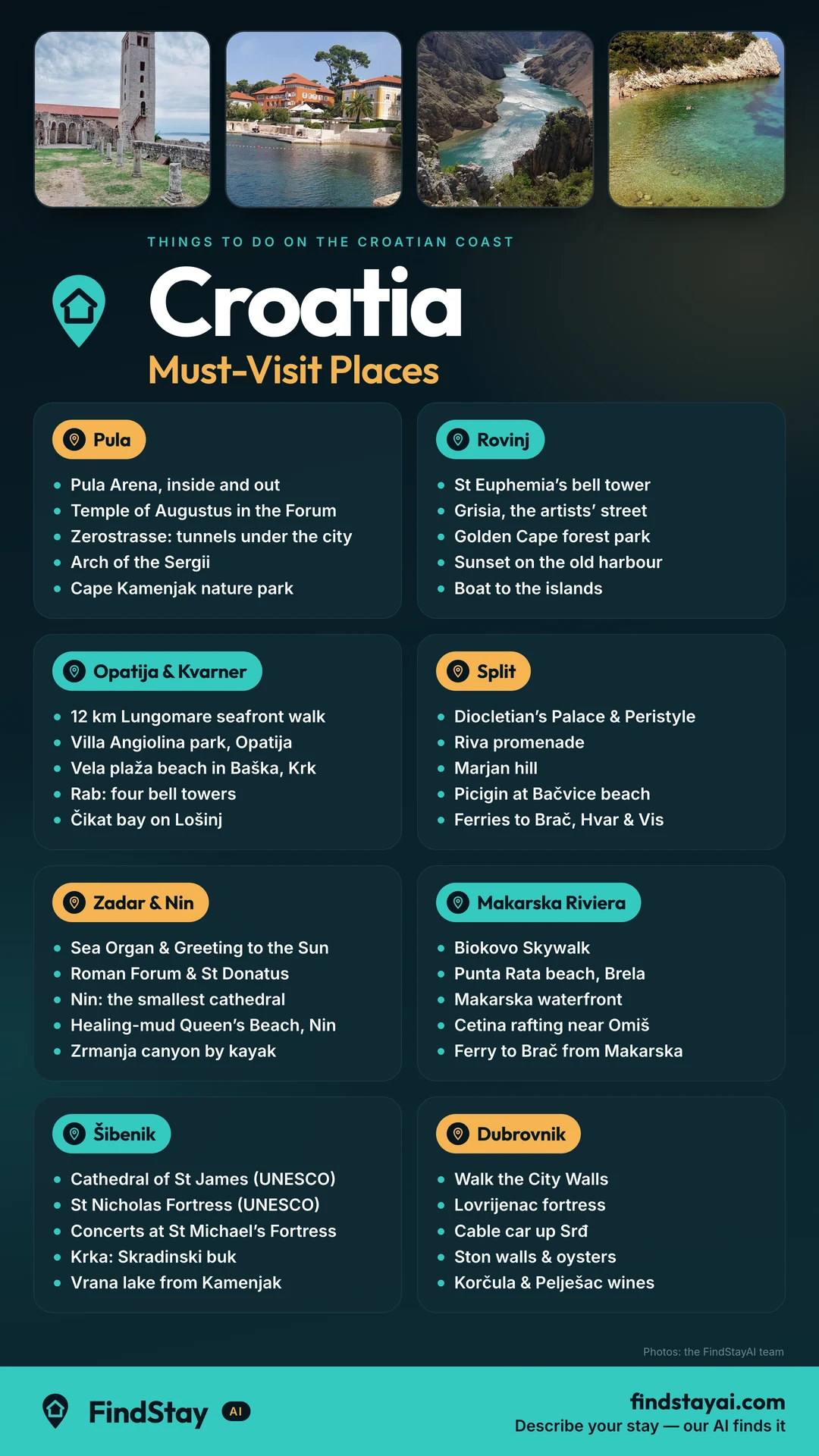
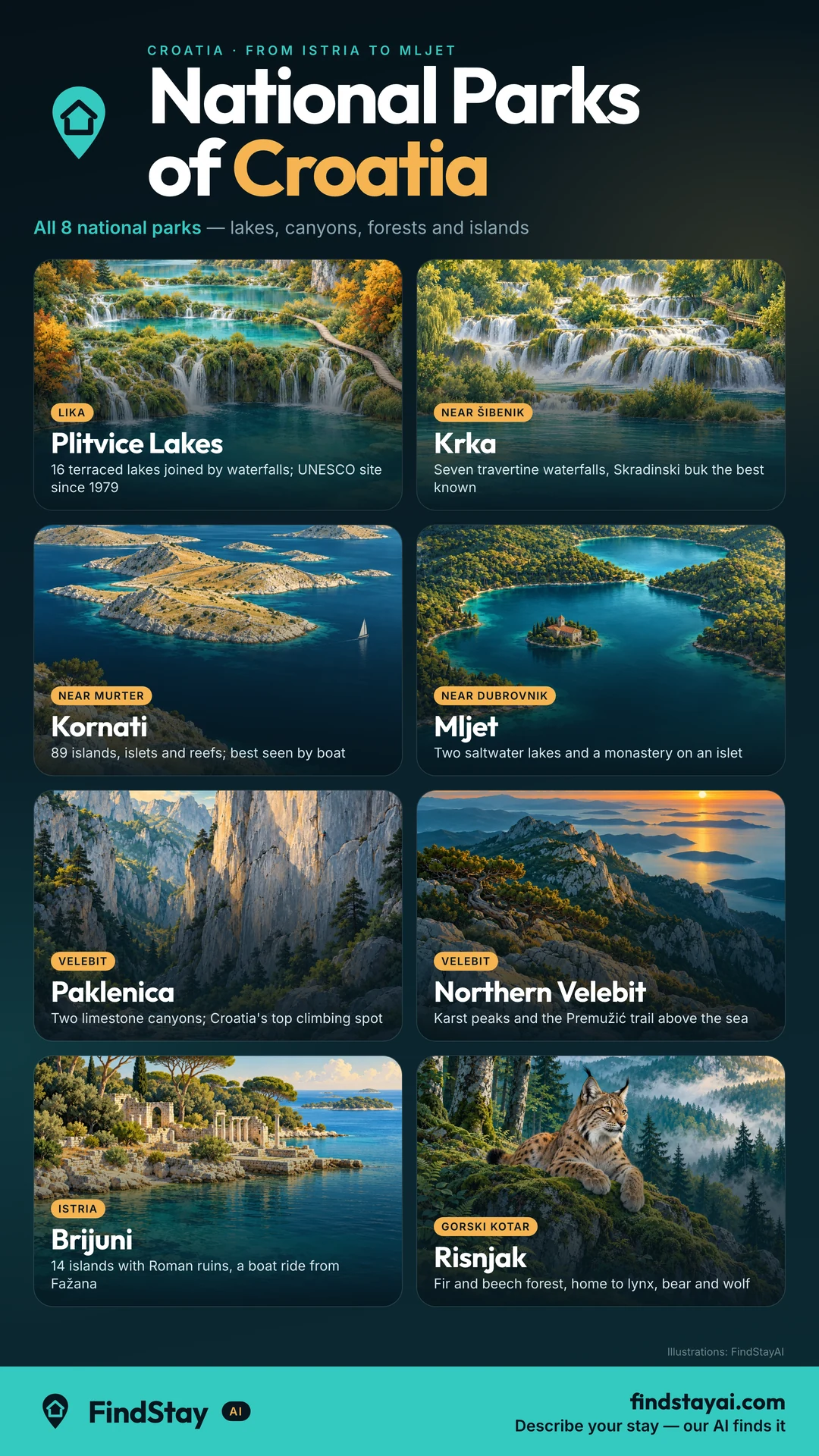
Free to download, print, pin or share — please keep the findstayai.com credit on the image. Tap an infographic to open it larger.
Found your favourite on the list?
Tell our AI where you want to go and what matters to you — “a quiet apartment near a sandy beach in Nin for two adults and a dog, mid-June” — and it searches live availability for you. Start a search or browse all destinations.