 HR
 DE
 FR
 IT
Hvar island: beaches, towns and places to stay
Croatia's longest island and one of its sunniest: a Venetian harbour town under a hilltop fortress, one of Europe's oldest towns, lavender and vineyards inland, and dozens of pebble coves, an hour by catamaran from Split.
Search stays on HvarHvar is a long, narrow ridge of an island, around 70 km from end to end and about 10 km across at its widest, with Sveti Nikola (628 m) as its highest point. It has two towns, Hvar and Stari Grad, and two municipalities, Jelsa and Sućuraj, with roughly 10,700 residents in all. The island is known for its sunshine, more than 2,700 hours a year on the long-term average, for its lavender, and for wine: Plavac mali from the steep southern slopes and whites from the plain between Stari Grad and Jelsa.
Hvar town, on the south-west coast, is the busy one. Its main square, the Pjaca, is the largest in Dalmatia and ends at the Cathedral of St Stephen; on the harbour side stands the Arsenal with a theatre founded in 1612 on its upper floor, which the local tourist board describes as the first public theatre in Europe. A 15 to 20 minute climb takes you to the Fortica fortress (also called Španjola) for the view over the roofs and the Pakleni islands. The town has the island's nightlife, the catamarans and the taxi boats, and the highest prices.
Stari Grad, where the car ferry from Split arrives, is far quieter. Greeks from the island of Paros founded it as Pharos in 384 BC, and the fields they laid out behind it, the Stari Grad Plain, are still farmed in the same pattern and have been on UNESCO's World Heritage list since 2008. In town, look for Tvrdalj, the fortified summer house of the Renaissance poet Petar Hektorović, built around a fishpond.
Jelsa and Vrboska, on the north coast, are the family side of Hvar, with the island's few sandy beaches, pine shade and flat walks along the shore. Vrboska is often called little Venice for the small bridges over its narrow inlet, and its fortified church of St Mary was built to keep out raiders in the 16th century. On Maundy Thursday night the villages around Jelsa walk the Za križen procession, some 25 km through the night, which is on UNESCO's list of intangible heritage.
Beyond the Pitve tunnel lies the south coast: Zavala and Ivan Dolac, vineyards dropping to the sea and a view of the uninhabited island of Šćedro. In the far east, Sućuraj is a small harbour with the short ferry to the mainland. Stay in Hvar town for atmosphere and boats, in Stari Grad for calm and the ferry, in Jelsa or Vrboska with children, and on the south coast if all you want is a cove and a glass of red.
Beaches
Pokonji Dol
The largest beach of Hvar town, about 1.5 km east of the centre: a pebble bay facing a lighthouse islet, with sunbeds, showers and restaurants. Walk there in 20 to 30 minutes along the coast path or drive in five; the car park fills early in July and August. The easiest choice if you are staying in town without a car.
Mekićevica and Milna
From Pokonji Dol the coast path continues for another 20 to 30 minutes to Mekićevica, a pebble and rock cove with no road at all, partly used by naturists. Milna, about 4 km east of Hvar, has two pebble beaches in front of a small village with restaurants, a few minutes away by car or by taxi boat in season. Good with children.
Zaraće
Two coves below a hamlet about 6 km east of Hvar town. Velo Zaraće is a wide pebble beach in a long lagoon with two restaurants and little shade; Malo Zaraće is smaller and rockier, with more privacy. The access road is steep and narrow and parking is very limited, so come early.
Dubovica
The best-known beach on the island: a broad arc of white pebbles beside an old stone house, about 8 km east of Hvar town. You park along the main road and walk down a steep, rocky path for 10 to 15 minutes, or arrive by taxi boat. There is a beach bar and a konoba but little natural shade. Not suitable for pushchairs.
Pakleni islands: Palmižana, Ždrilca and Jerolim
A chain of 16 wooded islets opposite Hvar harbour, reached by taxi boat from the waterfront. Palmižana on Sveti Klement is a shallow bay with a sandy seabed and restaurants, a short walk across the island from the landing. Ždrilca and Mlini on Marinkovac are pebble coves with calm water for snorkelling, Stipanska has a beach club, and Jerolim, the nearest islet, has long been a naturist island.
Bonj and the town promenade
West of the harbour, a seafront promenade leads in about ten minutes to Bonj, a historic stone bathing terrace from the early 20th century with cabanas, sunbeds and a restaurant, now a paid beach club. A little further on, Majerovica is a small pebble beach where dogs are allowed.
Lučišća and Jagodna (Sveta Nedjelja)
The wildest stretch of the south coast. Lučišća is a pebble bay under cliffs several hundred metres high, reached by boat or by a short narrow footpath from the nearest parking. Jagodna, between Sveta Nedjelja and Ivan Dolac, is a pebble beach under red rock and pines with a restaurant. Note that Hvar has a second Jagodna and a second Lučišće on the north coast near Brusje.
Zavala and Ivan Dolac
Zavala has more beaches than any other place on the island: a string of pebble coves along a 2 km seafront, facing Šćedro. Ivan Dolac, 3 km to the west, has white pebbles and a gentle entry that suits children. Both are reached from Jelsa through the Pitve tunnel, which is single-lane with a traffic light, so expect a short wait.
Mina and Grebišće (Jelsa)
Sandy beaches are rare on Hvar, and these are the two best. Mina, about 1 km from Jelsa's waterfront, has showers, changing cabins, sunbeds, an aqua park and pine shade. Grebišće, about 2 km from the centre, is very shallow for a long way out, with a beach bar and parking. Both are ideal for small children.
Soline (Vrboska)
A family beach on the Glavice peninsula, a walk along the shore from Vrboska: fine pebbles and sand with a sandy bottom, a restaurant, a café and parking. Further out on the peninsula the shore turns to flat rocks, and the tip is a naturist area.
Lanterna (Stari Grad)
Stari Grad's town beach lies on the north side of its long bay, 10 to 15 minutes on foot from the centre: pebbles and concrete terraces with restaurants nearby. Bring swim shoes, as on most beaches on the island.
Česminica and Mlaska (Sućuraj)
Česminica is the town beach of Sućuraj, five minutes from the harbour, with pebbles, a shallow sandy bottom, showers and a fenced swimming area. Mlaska, about 4 km to the north-west, is a sandy, shallow bay with a separate naturist cove. Handy if you arrive on the Drvenik ferry.
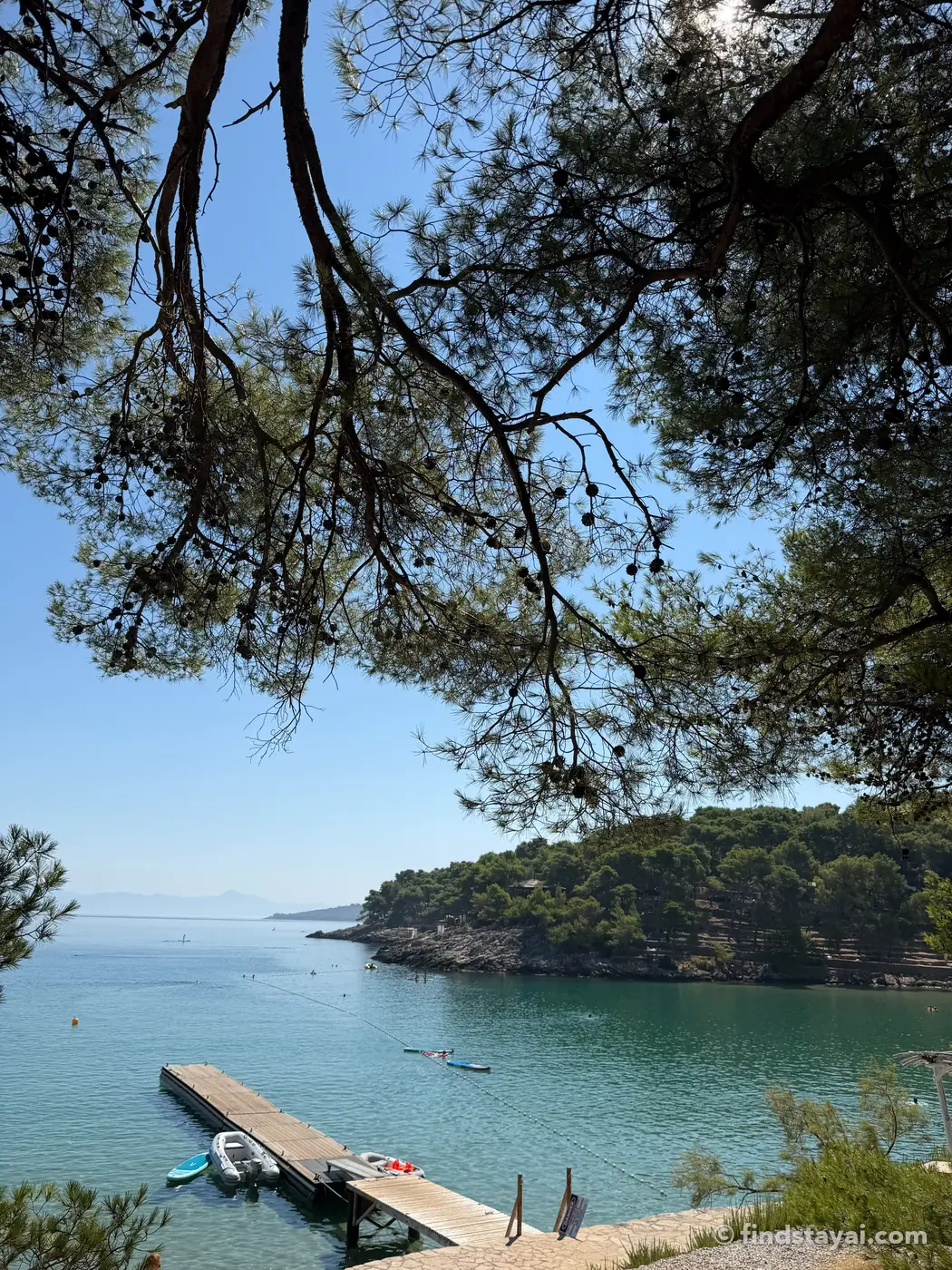
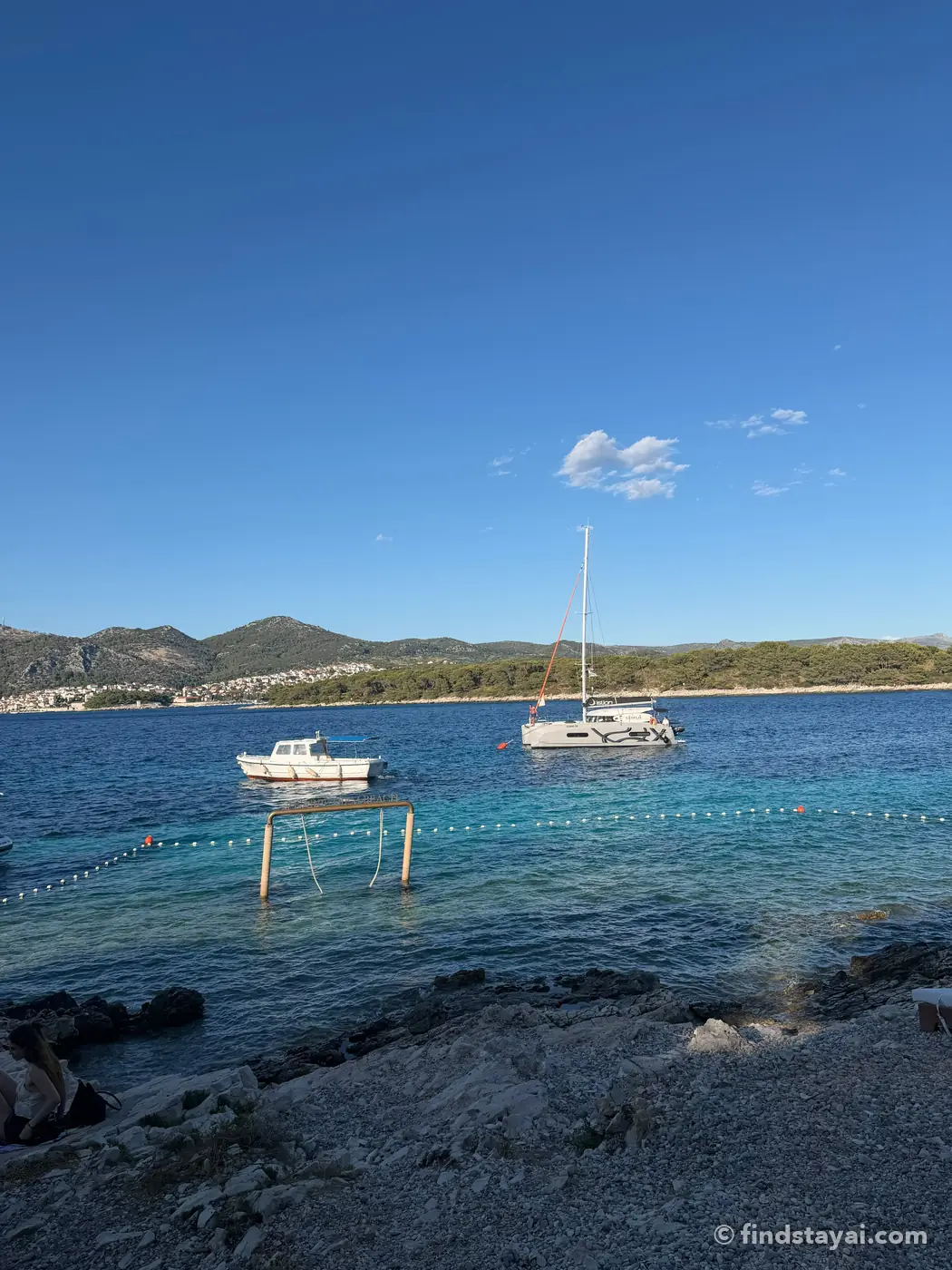
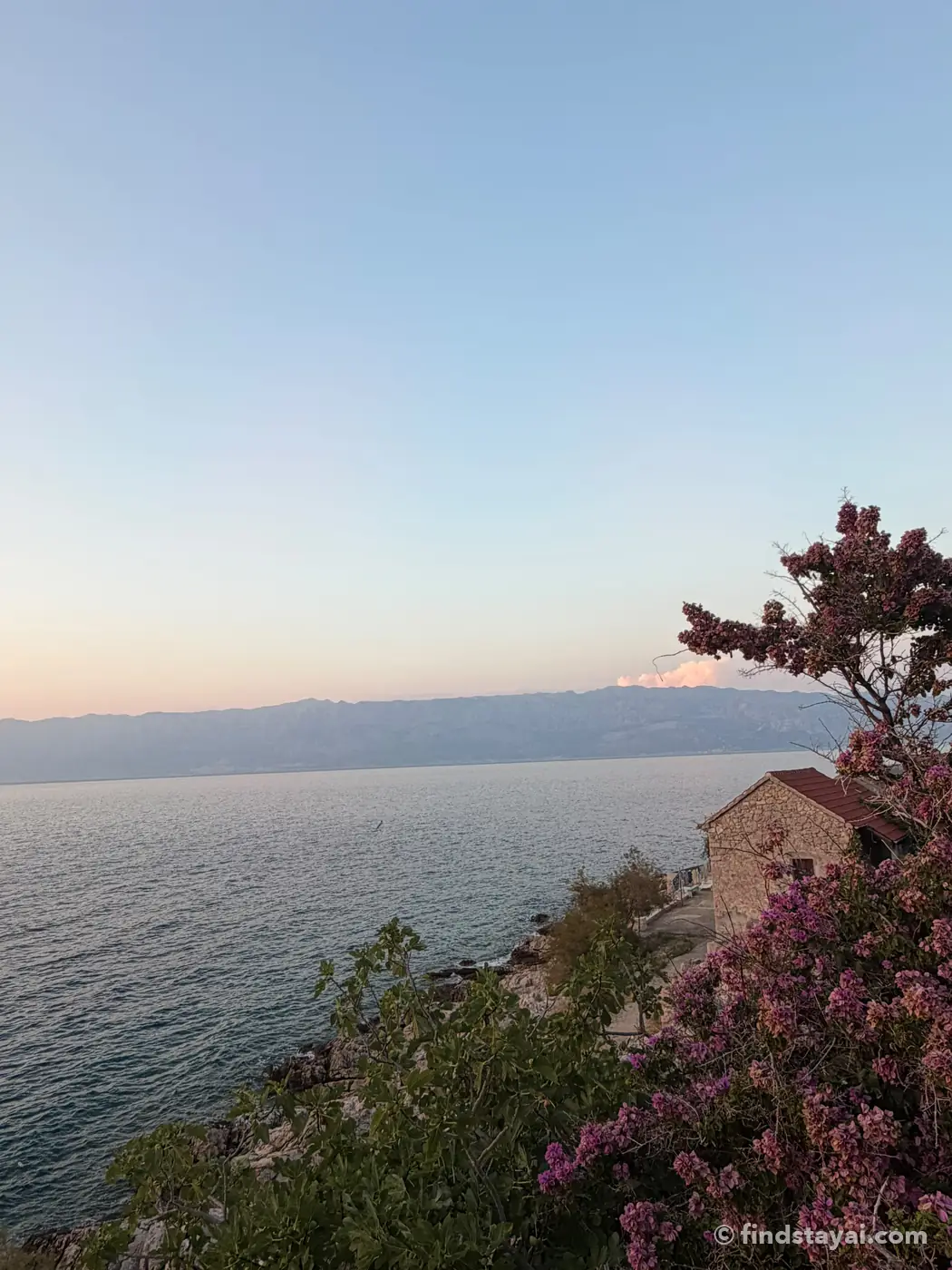
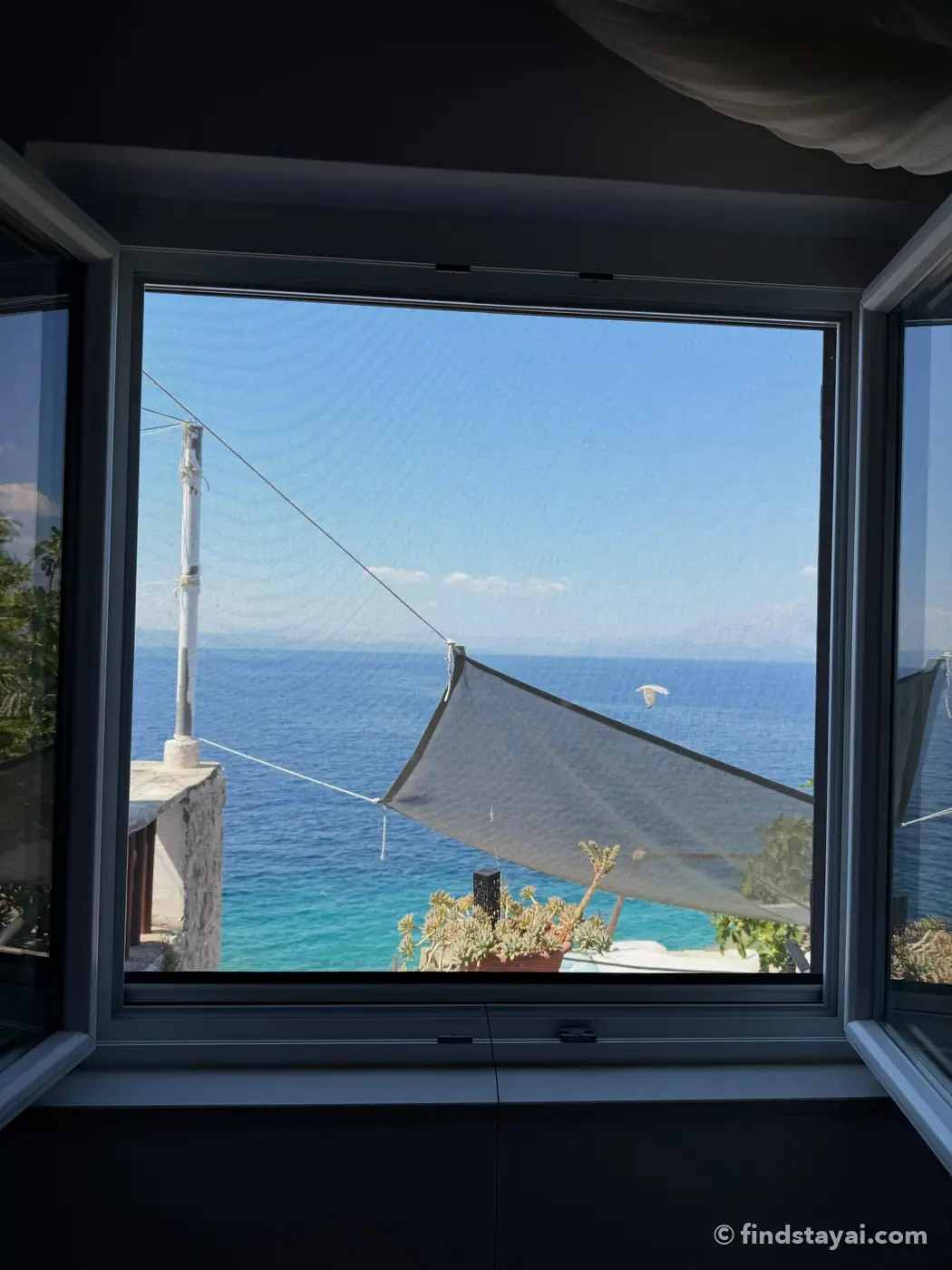
Our photos: Jelsa, Gdinj and the Pakleni Islands
Taken by our team on the coast. Tap a photo to open it larger.
Hvar island map: beaches and sights
Old forts and churches, beaches, viewpoints and nature, with how to get there and how long a visit takes. Tap a pin or a place in the list.
- 1
Tvrđava Fortica (Španjola)
HeritageFortress above Hvar town, begun after 1278 and rebuilt in 1551, with the best view over the harbour and the Pakleni islands.
- 2
Pjaca, katedrala sv. Stjepana i Arsenal s kazalištem
HeritageThe largest square in Dalmatia, closed by the Cathedral of St Stephen; beside the harbour stands the Arsenal with the theatre founded in 1612. The square is free, the cathedral and theatre charge a small fee.
- 3
Franjevački samostan, Hvar
HeritageA 15th-century monastery on the shore south of the harbour, with a small museum and a large painting of the Last Supper in the refectory.
- 4
Tvrđava Napoleon – vidikovac
ViewpointsA French fort from the early 19th century on the hill above Fortica, now an observatory. You cannot go inside, but the view from around it reaches across the town, the Pakleni islands and Vis.
- 5
Bonj
BeachesHistoric stone bathing terrace from the early 20th century, today a paid beach club with cabanas, sunbeds and a restaurant.
- 6
Pokonji Dol
BeachesThe largest beach of Hvar town: a pebble bay facing a lighthouse islet, with sunbeds, showers and restaurants.
- 7
Mekićevica
BeachesA pebble and rock cove with no road access, partly naturist, with natural shade on the rocks.
- 8
Milna
BeachesTwo pebble beaches in front of a small village with restaurants; an easy choice with children.
- 9
Zaraće (Velo i Malo)
BeachesTwo coves below a hamlet: a wide pebble beach in a long lagoon with two restaurants, and a smaller, rockier cove next to it.
- 10
Dubovica
BeachesThe island's best-known beach: an arc of white pebbles beside an old stone house, with a beach bar and a konoba.
- 11
Crvene stijene
NatureRed limestone cliffs dropping straight into the sea on the south coast between Hvar town and Sveta Nedjelja.
- 12
Jerolim (Pakleni otoci)
BeachesThe islet nearest to Hvar town, long known as a naturist island: rocks and pebbles, pine shade and a simple bar.
- 13
Ždrilca (Marinkovac, Pakleni otoci)
BeachesPebble and rock coves in a calm channel between the islets, with several konobas; good for snorkelling.
- 14
Palmižana (Sveti Klement, Pakleni otoci)
BeachesA shallow bay with a sandy seabed, restaurants and a botanical garden on the largest of the Pakleni islands.
- 15
Sveti Nikola (628 m)
ViewpointsThe highest point of the island, with a small chapel and a view of Brač, Vis, Korčula and Pelješac. No shade or water on the way.
- 16
Lanterna (Stari Grad)
BeachesStari Grad's town beach on the north side of the bay: pebbles and concrete terraces, with restaurants nearby.
- 17
Tvrdalj Petra Hektorovića (Stari Grad)
HeritageThe fortified 16th-century summer house of the poet Petar Hektorović, built around a courtyard with a fishpond.
- 18
Starogradsko polje
HeritageFields laid out by Greek settlers in the 4th century BC and farmed in the same pattern ever since; a UNESCO World Heritage site since 2008.
- 19
Crkva-tvrđava sv. Marije (Vrboska)
HeritageA church fortified around 1575 against raids from the sea, with a view over Vrboska from the roof.
- 20
Soline (Vrboska)
BeachesA family beach of fine pebbles and sand with a sandy bottom, a restaurant, a café and parking.
- 21
Mina (Jelsa)
BeachesA sandy beach with showers, changing cabins, sunbeds, an aqua park and pine shade.
- 22
Grebišće (Jelsa)
BeachesA sandy bay that stays very shallow far from the shore, with a beach bar and pine shade.
- 23
Humac
HeritageAn abandoned shepherds' village of stone houses in the hills east of Jelsa, with a small museum and a konoba open in summer.
- 24
Zavala
BeachesA string of pebble coves along a 2 km seafront on the south coast, facing the island of Šćedro.
- 25
Mlaska (Sućuraj)
BeachesA sandy, shallow bay on the north coast near Sućuraj, with a separate naturist cove.
- 26
Česminica (Sućuraj)
BeachesSućuraj's town beach: pebbles with a shallow sandy bottom, showers and a fenced swimming area.
Times are approximate and depend on traffic and season. Map data © OpenStreetMap contributors.
Getting there and around
From Split, Jadrolinija's car ferry sails to Stari Grad in about two hours, up to seven times a day in high summer. Passenger catamarans (Jadrolinija, TP Line, Krilo) run from Split to Hvar town in about an hour, and a daily catamaran links Split with Jelsa via Bol on Brač. From the south, the car ferry from Drvenik on the mainland reaches Sućuraj in 30 minutes, but from there it is close to 80 km and up to two hours on a narrow road to Hvar town. Seasonal catamarans also connect Hvar town with Korčula and Dubrovnik. The nearest airport is Split. The ferry port lies about 2 km outside Stari Grad, some 20 km and 20 to 30 minutes from Hvar town; buses meet the ferries.
Stays on Hvar right now
Loading current offers…
Tips before you book
- The car ferry from Split goes to Stari Grad, not Hvar town. Only Stari Grad and Sućuraj take cars; Hvar town and Jelsa are served by passenger catamarans.
- In summer buy the ferry ticket for a specific sailing and be at the pier 45 to 60 minutes early with a car.
- The old centre of Hvar town is for pedestrians. Car parks at the edge fill up in season, so check parking with your host before you book.
- Most beaches are pebble or rock: pack swim shoes. For sand go to Mina, Grebišće, Soline or Mlaska.
- Dress when you leave the beach: signs in Hvar town warn of fines for walking through the centre in swimwear.
- The same names repeat across the island: there are two Jagodnas, two Lučišćes and a Milna on Hvar as well as on Brač, so check the map before you set off.
Frequently asked questions
How do you get to Hvar island?
By sea from Split. The Jadrolinija car ferry sails to Stari Grad in about two hours, and passenger catamarans reach Hvar town in about one hour. From the Makarska side, the car ferry from Drvenik to Sućuraj takes 30 minutes. Hvar has no airport with scheduled flights; the nearest is Split.
Can you take a car to Hvar?
Yes, on the Split to Stari Grad ferry or the Drvenik to Sućuraj ferry. Catamarans to Hvar town and Jelsa carry passengers only. A car is useful for the beaches east of Hvar town and for the south coast, but you do not need one if you stay in Hvar town and use taxi boats.
Which is the best beach on Hvar?
Dubovica is the most photographed, a white pebble bay 8 km east of Hvar town reached by a steep footpath. For an easy day from town choose Pokonji Dol or a taxi boat to Palmižana on the Pakleni islands; for families, Mina and Grebišće in Jelsa; for quiet coves, Zavala on the south coast.
Are there sandy beaches on Hvar?
A few. Mina and Grebišće in Jelsa and Mlaska near Sućuraj are sandy, Soline in Vrboska and Česminica in Sućuraj have a sandy bottom, and Palmižana bay on the Pakleni islands has a shallow sandy seabed. Almost everywhere else the shore is pebble or rock.
How do you get to the Pakleni islands?
By taxi boat from the waterfront in Hvar town; boats run regularly through the day in season to Jerolim, Marinkovac (Ždrilca, Stipanska) and Palmižana on Sveti Klement. Check the time of the last boat back. The name comes from paklina, the pine resin once used to coat ships, not from the word for hell.
Where is the best place to stay on Hvar?
Hvar town for sights, restaurants, nightlife and boats to the Pakleni islands. Stari Grad for a calmer old town right by the car ferry. Jelsa and Vrboska for families and sandy, shallow beaches. Zavala, Ivan Dolac and Sveta Nedjelja for quiet coves and vineyards on the south coast.
Where is the best place to stay on Hvar with children?
Jelsa and Vrboska on the north coast. Mina and Grebišće in Jelsa and Soline in Vrboska are sandy and shallow, there is pine shade right down to the sea and a flat promenade along the shore, and evenings are much quieter than in Hvar town. Both are about 15 minutes by car from the Stari Grad ferry, and catamarans from Split also stop in Jelsa.
When is the best time to visit Hvar?
June and September: the sea is warm enough to swim, ferries run on their summer timetable and the beaches and car parks are less crowded than in July and August. The swimming season usually lasts from June into early October.